
Coordinate Geometry - An Introduction Practice 2
This section provides three targeted practice questions to help students strengthen their knowledge in applying the rules and techniques of basic coordinate geometry.
Related Lessons:
Practice 2 - Question 1

Variables \(x\) and \(y\) are related by the equation \(2y=4x-3\). The table shows some corresponding values of \(x\) and \(y\).
- Calculate the values of a and b
- Using a scale of 2cm to represent 1 unit for both the \(x\) and \(y\) axis, plot the points given in the table and join them with a straight line.
- Use your graph to find the value of \(x\) when \(y=2\)
- From the graph drawn, determine the gradient of the line \(2y=4x-3\)
- On the same axes, draw the graph of \(x=-1.5\)
- Hence, write down the coordinates of the point of intersection of the graphs of \(2y=4x-3\) and \(x=-1.5\)
Answers:
a) \(a=-3.5,\ b=2.5\)
c) \(x=1.75\)
d) gradient is 2
f) \( \left(-1.5,\ -4.5\right)\)
Practice 2 - Question 2
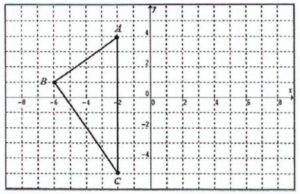
In the diagram shown, A, B and C are the vertices of a triangle.
- Write down the coordinates of point C
- Calculate the gradient of line BC
- Calculate the area of triangle ABC
- Find the coordinates of the point D such that ABCD is a rectangle.
Answers:
a) \( C\left(-2,-5\right)\)
b) Gradient is \(-\frac{3}{2}\)
c) Area is 18 units2
d) \(D\left(2,-2\right)\)
Practice 2 - Question 3
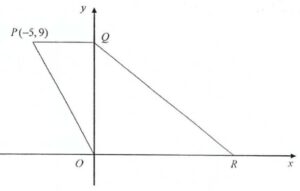
In the diagram, OPQR is a trapezium where O is the origin, and PQ is parallel to OR. The coordinate of P is \(\left(-5,\mathrm{\ 9}\right)\).
- State the coordinates of Q
- Write down the equation of line PQ
- Find the equation of the line OP
- Given that the area of the trapezium OPQR is 72 \(units^2\), find the coordinates of R.
Answers:
a) \(Q\left(0,9\right)\)
b) \(y=9\)
c) \(y=-\frac{9}{5}x\)
d) \(R(11, 0)\)
Step By Step Full Solution
For graph-related questions, students gain a clearer understanding when they can follow a complete, step-by-step explanation. The video below provides full solutions to the three questions above, carefully demonstrating each stage of the working and explaining how the final answers are obtained.