Coordinate Geometry - An Introduction Practice 1
This section includes three focused practice questions to help students practise and reinforce the rules and techniques, strengthening understanding of basic coordinate geometry.
Related Lessons:
Practice 1 - Question 1
The table above shows the value and corresponding value for the equation \(y=\frac{4x+400}{25}\).
- Find the values of a and b
- Using a scale of 1cm to represent 10 units for \(0\le x\le150\), and a scale of 1cm to represent 2 units for \(0\le y\le44\), plot the points in the table and join them with a straight line
- Find the gradient of the graph
- Find the corresponding value of \(x\) for \(y=36\)
Answers:
a) \(a=20,\ b=30.4\)
c) Gradient is \(\frac{4}{25}\)
d) \(x=125\)
Practice 1 - Question 2
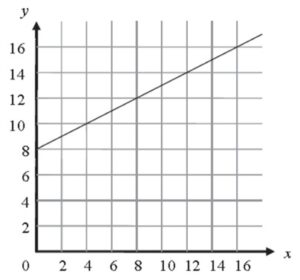
The diagram above shows a straight line
- Find the gradient of the straight line
- Write down the equation of this straight line in the form \(y=mx+c\), where m is the gradient and c is the y-intercept.
Answers:
a) Gradient = \(\frac{1}{2}\)
b) \(y=\frac{1}{2}x+8\)
Practice 1 - Question 3
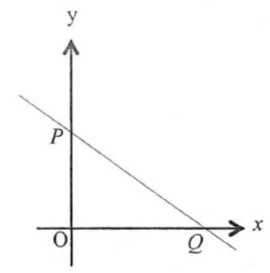
The diagram shows a sketch of the graph of \(3y=12-2x\). The line crosses the axes at P and Q. Find
- the coordinates of P
- the coordinates of Q
- the gradient of line PQ
Answers:
a) \(P\left(0,4\right)\)
b) \(Q\left(6,0\right)\)
c) \(Gradient=-\frac{2}{3}\)
Step By Step Full Solution
The video below presents a complete, step-by-step solution to the three questions above. Every stage of the working is clearly explained, allowing students to see exactly how each answer is developed and properly presented. This is especially helpful for students learning coordinate geometry for the first time, as it builds understanding through detailed guidance and structured explanation.